Tuesday, September 25, 2012

Where'd You Go, Bernadette


This is the best new novel I have read so far this year.  It is the story of what happens when Bernadette Fox's life goes off the rails at the prospect of a family cruise to Antarctica, as recounted by her daughter Bee through notes, letters, and emails.  I pretty much hate the epistolary novel but here the form works brilliantly.  Satirical, funny, relentlessly entertaining, smart, and even touching.  Maybe I've been reading too many crime novels lately and my senses are warped but I can't remember reading anything this fun in a long time (A Visit from the Goon Squad maybe?)  Even the title of the book and its cover are wonderful.  My wife also read it and while she enjoyed it, she is of the opinion that I have gone overboard in my enthusiasm for this book.  That's okay - everyone thought the same thing about Bernadette, so I am in good company.

Wednesday, September 05, 2012

Escape from DC

We rented a house in a small town on the shore of the Cheasapeake Bay for Labor Day weekend. I packed a box of books so I would have a good supply of reading material for our vacation but when we got here, we found a bookcase full of good books. I knew the house had a small offering of books and DVDs but was pleasantly surprised by what we found - a really good selection of Scandinavian crime fiction.  (Hakan Nesser, Maj Sjowall&Per Wahloo, Stieg Larsson, Jo Nesbo, Henning Mankell, Arnaldur Indridason, Kjell Erickson, Johan Theorin, Karin Fossum, and Lars Kepler.)  If I had been under house arrest and had to stay longer I would've enjoyed reading what was on hand.  Plus, they had two by William Boyd, a Tana French, a Richard Price, and a few other good choices.

I never got around to reading anything from the house library.  Instead, I wound up immersed in entertainment about escaping from prisons.  I started out reading Richard Stark's Breakout.  Our first night we watched Chicken Run (a really great escape movie) on DVD.  After Breakout, I moved on to Donald Westlake's Help I Am Being Held Prisoner.  I also polished off Richard Stark's Nobody Runs Forever and Lawrence Block's Hit Man.

Breakout was published in 2002 and Help I Am Being Held Prisoner was published in 1974 but Westlake used the same name for the prison in each book (Stoneveldt and Stonevelt).  Not a big deal, I realize, but it was strange to encounter the names in back to back books.  I found two cartoons from the Spectator in Breakout.

(Something is going haywire here and I can't format anything the right way.)

It was hard to find a copy of Help I Am Being Held Prisoner.  I wound up buying an ex-library copy without a dust jacket for 17 cents from Atlanta via Canada. (Property of the U.S. Army, Fort Sam Houston, Texas, Branch 1 Library)  Very ugly, but I enjoyed reading it.  


Monday, August 20, 2012

Philip K. Dick - Banished!

I spent all day selecting books to put into storage - Bookglutton is going on a diet.  I meant to count all the books going into storage but I forgot to start.  So far, I have nine boxes packed and sealed.  Nine boxes sounds like a lot, and for a normal person, I suppose it is. When Mrs Bookglutton returned home from work, she looked at the nine boxes and remarked that I had yet to make much progress.  (My guess - 600 packed.)

Most of my books I genuinely love.  So it is difficult deciding what makes the cut and what does not.

Philip K. Dick - he did not make the cut.  He had a limitless capacity to invent some really great material but he is, by far, the worst writer of anyone who is a giant in his or her genre.  I can't say his books brought me much pleasure.  They are hard to get through.  (I've never been able to finish Ulysses or Finnegans Wake, either.) See the movie of any PKD book instead of trying to read it.

Someone needs to rewrite all of his books.  I know there are copyright restrictions that would prevent this but someone really should redo all of his books.  He was crazy and on drugs - so very creative but the craft suffered terribly.  There are a bunch of stories about how Gordon Lish massively edited Raymond Carver's work and that reworking is what made Carver great.  I wish someone had done that for Dick.

I found a note written on a bookmark in my copy of VALIS.
Chapter 9 is a long way into a book for it to start to get good.

Even the biography had to go.
Up next:  I tackle books on history.

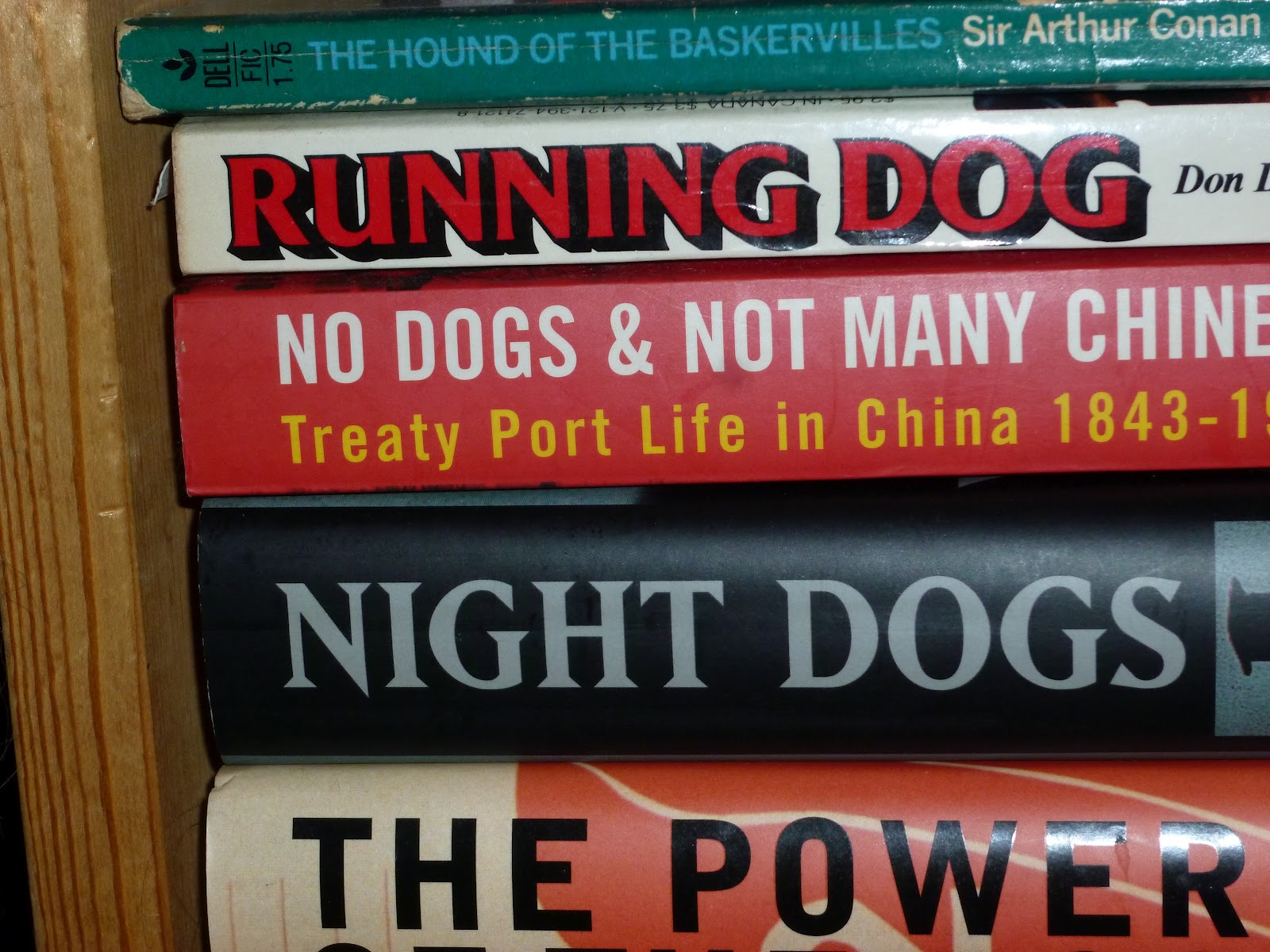
My assistant saved a copy of The Hound of the Baskervilles to add to his personal collection.

Sunday, August 05, 2012

Big in Japan

My favorite book of 2011 was Haruki Murakami's 1Q84 and after spending three weeks immersed in it, I wanted to read more Japanese fiction.  So I read some more Murakami.  (My wife just bought me the three volume, slip-cased, paperback edition of 1Q84 and I think I am going to re-read it.)  And I rounded up all the Japanese fiction scattered around our place and turned up, among many titles, 2011's other big Japanese novel, Keigo Higashino's The Devotion of Suspect X

Suspect X got a lot of great reviews and was nominated for an Edgar Award for best mystery novel (it lost out to Mo Hayder's Gone - which I find fairly amazing as Gone only makes sense if one has read the two books before it - Skin and Ritual - and as much as I love Mo Hayder, Gone is bonkers - one of the subplots concerns two cops who should be in love with each other, but aren't speaking, independently working to destroy evidence and hide a body from a hit and run one of them is concealing from the book before).  Apparently, Keigo Higashino is the biggest writer in Japan but almost completely unheard of in the west.  I thought I knew a fair amount about contemporary Japanese fiction so this was a big surprise to me.   Suspect X is about a math teacher who helps his neighbor (with whom he is in love - unbeknownst to her) cover up the accidental murder of her ex-husband.  A squad of detectives and a physics professor match wits against this math teacher who has engineered the perfect cover up.  And not to give anything away but there is an incredible twist at the end - I knew something was coming but never would have thought of this in a million years.  The clues were there but most readers would never figure it out.

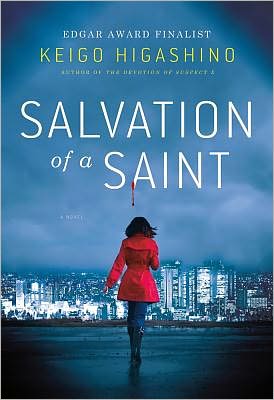
Just after I finished reading Suspect X, I received a review copy of the upcoming Keigo Higashino novel Salvation of a Saint (thank you MacMillan!).  It turns out that Higashino has written several books and stories with the cops and the physics professor (known as Professor Galileo) from Suspect X.  In Salvation of a Saint, they tackle the case of a mysterious poisoning that appears to be the perfect crime.  The book follows the detectives attempts to unravel a most amazing puzzle.  A wonderful read.  I hope this book is a big hit when it is published this fall.

After reading two of Higashino's books, I needed more.  I found an earlier novel called Naoko.  This appears to be the first book of his to be translated into English.  In it, a mother and daughter are in a deadly bus accident en route to a ski resort and somehow the mother's body dies but her mind/spirit jumps into the body of her 11 year old daughter.   Normally, I would hate this idea but here, well, it works.  When the husband realizes the wife is alive in the daughter, he doesn't tell anyone - and who would believe him anyway?  They return home from the hospital and attempt to rebuild and manage their lives and keep their secret.  Much of the story is how he reconciles that his wife now lives in the body of his daughter.  And this turned out to be a pretty good story.  Moving, even.  The lives of the other people from the bus crash come into play and the book ends with a pretty moving and satisfactory explanation/resolution.

Desperate for more Keigo Higashino, I scoured the web for more about him.  And it is really strange that there is so little written about him.  His American publishers compare him to James Patterson and Dean Koontz (in terms of sales and popularity, I think - Higashino is a much better writer).  He has dozens of untranslated novels [MacMillan - you have a lot of work to do - get cracking!] and many of them look really good.  And there is one oddity.  There may or may not be a book of his that has been translated into English but never published.  Random House seems to have commissioned a translation of something called Malice in 2009.  I have only found one mention of it - the website Fantastic Fiction has a description of the book and a picture of the cover.  The name of the translator is Radhica Capoor. She appears to exist but I can't find much information about her.  And there aren't any copies for sale anywhere - somehow this title gets mixed up with a manga called Chi's Sweet Home.  If this book exists, please publish it.  Or send me an electronic copy (epub or mobi).

I've moved on to Seicho Matsumoto now.  Vertical (which published Keigo Higashino's Naoko) has just released an old Matsumoto novel called Pro Bono.  A long time ago I read Inspector Imanishi Investigates and enjoyed it (even though I have forgotten what it was about - murder and trains?)  Pro Bono is the story of a famous attorney who takes on a case he initially refused when the suspect dies in prison and the attorney feels remorse for not having taken the case.  I'm halfway done with the book and am enjoying it.  I have two other old Matsumoto novels in the stack of Japanese fiction I rounded up and am eager to move on them.  Even though Matsumoto wrote many more novels, it seems only four of his books have been translated into English.

I have another novel and a collection of stories by Matsumoto to read if I am still in the mood after I finish Pro Bono.  Or I may have to ration them.

Sunday, June 10, 2012

Fatale and Fatale

In an unusual coincidence, I have been reading two things titled Fatale.  The first is the comic Fatale by Ed Brubaker and Sean Phillips and in a word, it is awesome.  A Lovecraftian-noir comic is a good description of it.  And I think it is a really great example of how good comics can be - this story would be too hard to do effectively as a movie and would lack its visual punch if done as a novel.  As a comic, it is brilliant.  It is an incredibly fun and exciting thing to read.  (Also, it reminds me of the RPG Call of Cthulhu I played as a kid - and one about espionage called, I think, Top Secret - which we used to add Cthulhu stuff to.)  And another thing - in addition to the great art in this series, the coloring is fantastic.  It is done by Dave Stewart, whose work I know from Hellboy and B.P.R.D.  I don't know much about coloring and lack the technical ability to describe the work but it just looks perfect.

The other Fatale I've been reading is the novel by Jean-Patrick Manchette, recently translated and attractively published by the New York Review of Books.  A slim novel, it concerns a woman who is on a killing spree in France.  I'm not done reading it yet but I am enjoying it immensely.  I wish more were available in English by Manchette.  I have another novel of his, The Prone Gunman.  And there is another I will soon buy.  I know he has done some work with Jacques Tardi (or maybe Tardi has adapted Manchette's work into graphic novels) and I will be looking into those soon.


Thursday, April 26, 2012

The Bond Market

James Bond has been making headlines across the world these past few weeks.  A new Bond movie is being filmed and all of the Bond books are getting new publishers and new editions across the world.  And most important for me, but in a bad way, there was the announcement that the newest James Bond novel is to be written by William Boyd.

William Boyd is one of my favorite writers.   I love his novels, his short stories, and his criticism.  Almost anything he does, really.  So I was saddened to learn that he was chosen by the Ian Fleming estate (or whoever it was) to write the next Bond novel because it means that we, in the long run, are being cheated out of a William Boyd novel.  I don't see the point (aside from the financial one) in hiring people to write sequels or new titles in a series after a writer has died.  Ian Fleming wrote 13 Bond novels and 9 Bond stories.  After him, we have: 1 book by Kingsley Amis, 2 by Christopher Wood, 16 by John Gardner, 12 books/stories by Raymond Benson, 1 by Sebastian Faulks, and 1 by Jeffery Deaver.  And the Young Bond series by Charlie Higson (the idea of which I quite like, I confess), The Moneypenny Diaries and the adventures of 003 and 1/2.  In total, there is way more non-Fleming James Bond than there is Ian Fleming James Bond.  Haven't we had enough James Bond by now?  Wouldn't it be better to read something new and promising (perhaps the forthcoming Paul Dark omnibus? or maybe the new Mark Mills novel House of the Hanged?) than ersatz James Bond?

I do like James Bond.  We had Book of the Month Club editions of the original novels around the house when I was a kid and I read some of them.  I saw all of the early movies - but nothing after Roger Moore.  I tried to read a John Garder book but didn't like it.  This clearly indicates that I am not the part of the target audience for the new Bond book.  And I would never dare to openly complain about a new Bond book if they hadn't poached somebody I loved.  (I know I make it sound like William Boyd was dragooned into doing this when that is probably not the case.  Or maybe they spied on him and found some dirt and blackmailed him into doing it?  No, probably the dump truck full of money did it.) 

I suppose I am prejudiced against the very idea of writers being commissioned to produce books like this.  Are they ever any good?  VC Andrews long dead, continues to churn out new books.  Dick Francis books continue to come out (though I gather his wife did much of the work on the originals so may this is okay).  Bourne ad infinitum. There are scores of Sherlock Holmes books - but how many do we remember?  The sequel to Gone With the Wind?  Bad idea.  Sequels to Pride and Prejudice?  [The more I think about this, the more I realize how prevalent this faux fiction is.  Clearly, we can't get enough of it.  Or make enough money off of it.]  On the other hand, I can't ever imagine J.K. Rowling's estate commissioning  new adventures of Harry Potter.  So not everyone has to do this.

I suppose this spy fiction kick William Boyd is on is consistent with his recent work.  Restless and Ordinary Thunderstorms fit in with this genre.  And his new novel, Waiting for Sunrise, is certainly about espionage.  According to a review of Waiting for Sunrise in the Times Literary Supplement, Boyd calls OT "Buchanesque" - so maybe he is a good choice to write this book.  And maybe it will be a good book.  In any case, my apologies for all this churlishness.

Wednesday, March 28, 2012

The Twelve and Re-reading

 
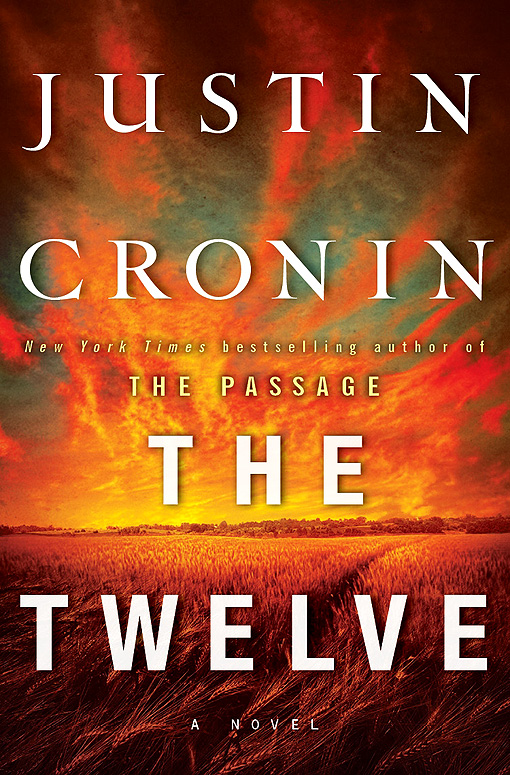
In my preview of new books for 2012, I omitted the one book I am most eager to get my hands on – Justin Cronin’s sequel to The Passage.  The March 16 issue of Entertainment Weekly reports that The Twelve will be released in the U.S. on October 16.  It also has a passage from the second chapter of the new book.  (This isn’t the first peek at the new book - the paperback edition of The Passage had a preview of The Twelve in it.)  (By the way, this American cover is pretty lame.  Looks more like a heart-wrenching tale about farmers at harvest time than the horrors of life long after a vampire apocalypse.  The UK cover is much better.)

I haven’t read either of these early excerpts because I fail to see the point in sampling a few hundred words when I still have months to wait for the next 600 pages.  (And for a book that is only part two of a trilogy.) And its not like I need a sample to ascertain whether or not I will want to read the book – I already know I do.  News of the impending arrival of The Twelve has me considering whether or not to re-read The Passage.  I probably will re-read The Passage by October – just to familiarize myself with the large cast of characters in it.  I rarely re-read anything anymore – it is hard to justify spending the time on something old when there is so much new to read. I used to reread Donna Tartt’s The Secret History and James Crumley’s The Last Good Kiss every few years.  Haven’t done that for a long time now. 

This past week I found myself re-reading Robertson Davies’ The Rebel Angels and enjoying it even more the second time around.   The Rebel Angels is volume one of The Cornish Trilogy – three books about the legacy of Francis Cornish, a Canadian art collector.  (Davies has a thing for trilogies – most famously The Deptford Trilogy as well as The Salterton Trilogy.)  In the first book, a cast of scholars at a Canadian college scheme to gain control of the estate of the recently deceased Francis Cornish.  This is a terrible simplification of a very rich and entertaining book whose subject matter runs from medieval history, mythology, folklore, gypsy culture, paleo-psychology, cultural fossils, art history, Rabelais, Renaissance manuscripts, academic satire, excrement, christianity, and murder.  These are, mostly, subjects I would run from - but from Davies the result is akin to the longest and most entertaining story you've ever heard (the book is very talky - lots of lengthy dialogue).